


Let EDU DOTCOM answer all your questions about studying in Japan
INFORMATION
Mark:
Education Pathway
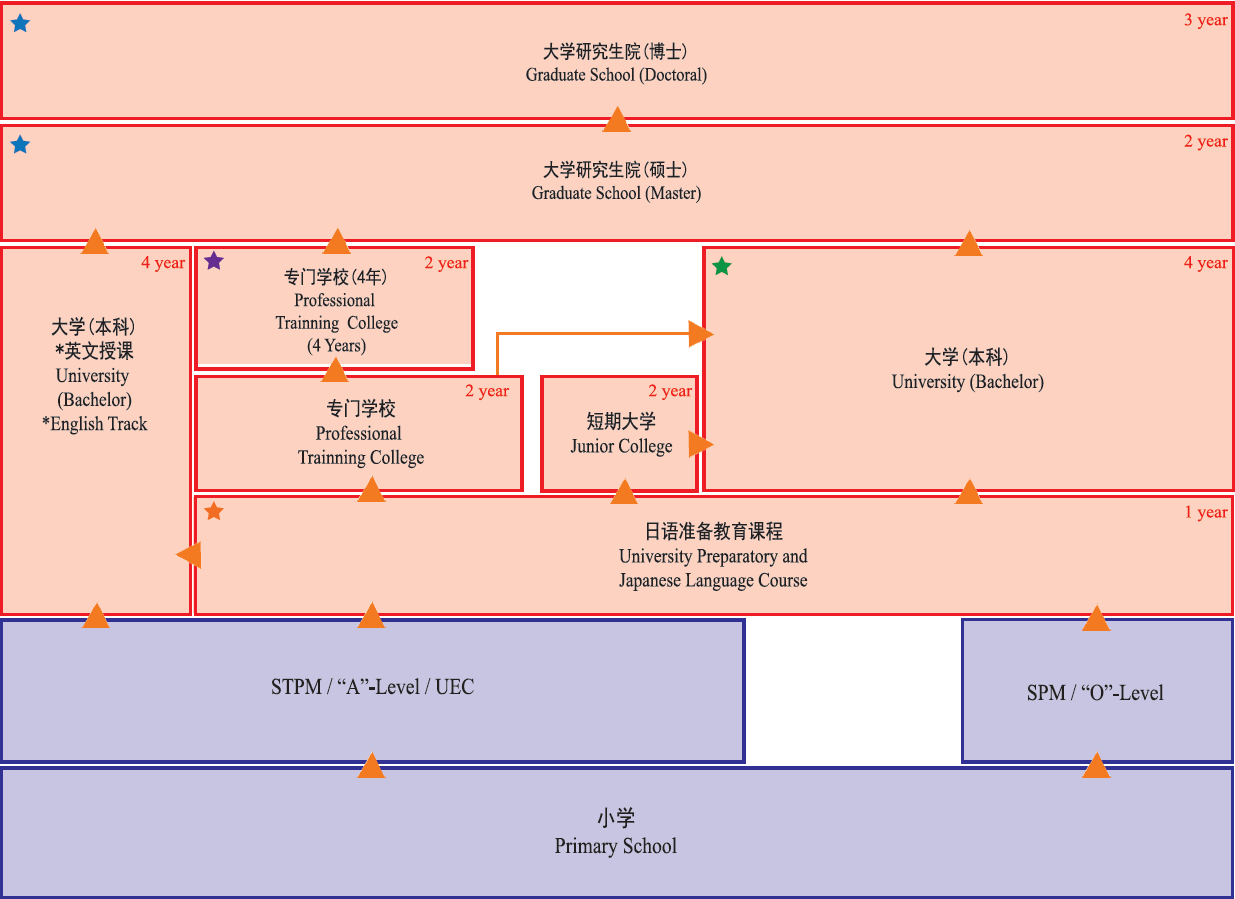
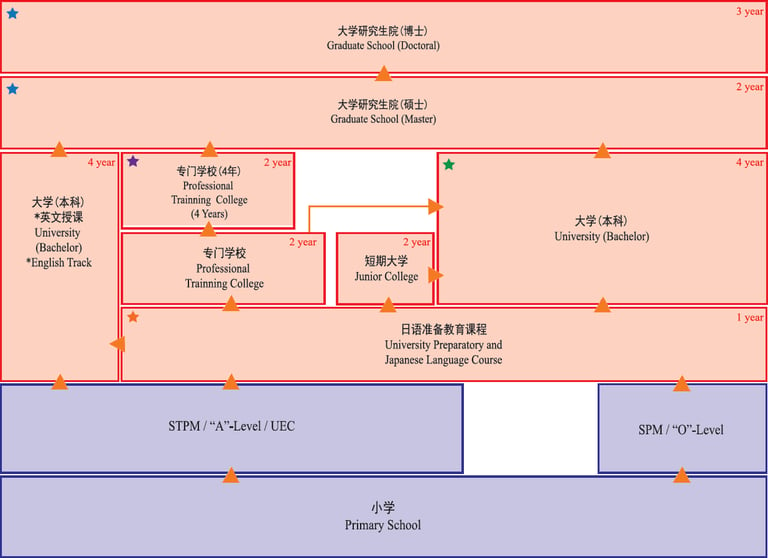
Malaysia domestic curriculum
Japanese domestic curriculum
Student can choose between 1 year, 1.5 years or 2 years course.
Student who complete a four-year program will a awarded a "Advanced Diploma" which equivalent to bachelor degree
Some majors require a 6-year program of study
Some university majors offer courses taught in English
* The above chart is an example of the educational pathway for Malaysian students and do not include all categories of schools in Japan.
Some Japanese universities (private universities) allow students who are currently studying at foreign universities to transfer and enroll in the second or third year of their undergraduate programs.
Student with less than 11 years of education background must apply for a japanese language school which are having university preparatory course.
The University preparatory course is offered in durations of 1 year, 1.5 years or 2 years. Students must successfully complete the applied course in order to receive a graduation certificate.
Note:
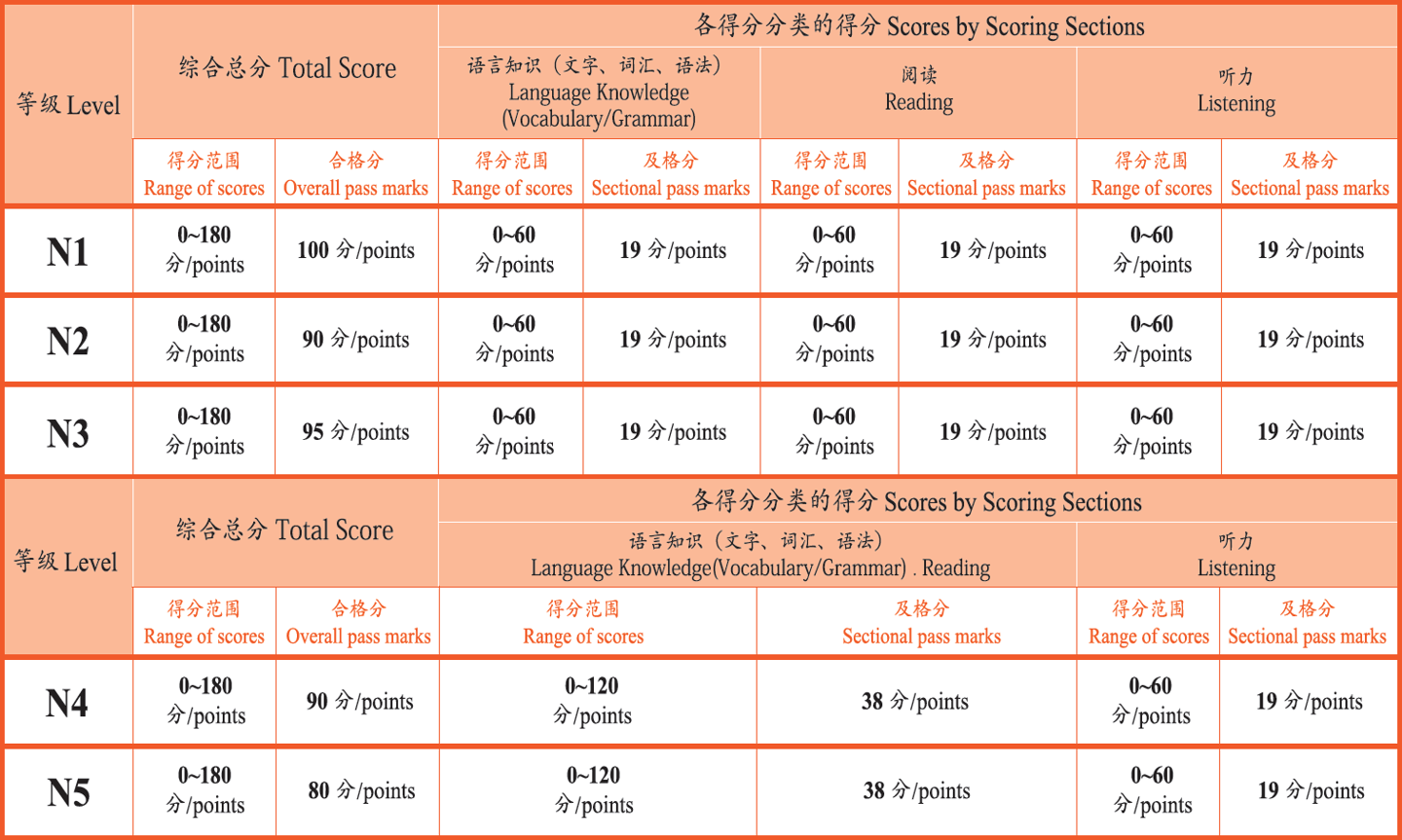
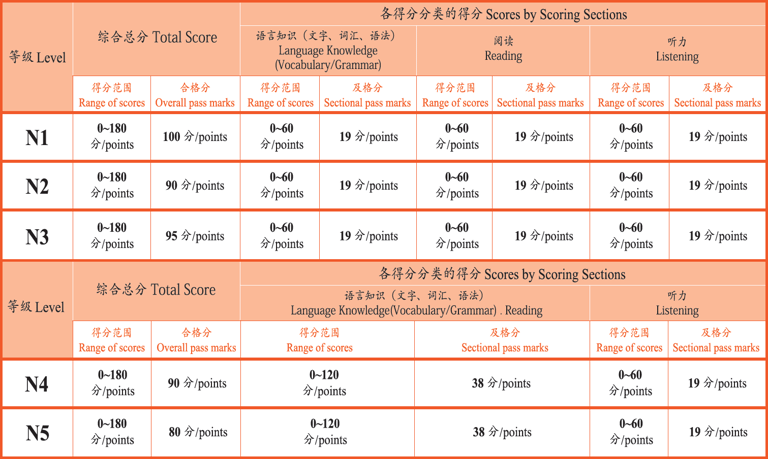
In order to pass, ① total score needs to be at or above the point required for passing (overall pass mark) and;② score in each scoring section needs to be at the minimum point required for passing (sectional pass mark). If there is even one scoring section where the score is below the sectional pass mark, examinees are determined to have failed, no matter how high the total score he/she might have. Scoring sections of N1~N3 and N4~N5 are different. Overall pass marks and sectional pass marks for each level are shown in the tabe below.
Examination System
The Japanese Language Proficiency Test (JLPT) is an examination conducted in Japan and overseas to assess and certify the Japanese language proficiency of non-native speakers. The test consists of five levels: N1, N2, N3, N4 and N5. N5 is the lowest level, while N1 is the highest. Each level has different test question tailored to accurately assess the proficiency of candidates at that level. It is important to choose the appropriate level that suits your own language abilities. In Japan, the test is held twice a year in July and December. However, overseas test administrations may vary, with some cities offering only the July exam and others offering only the December exam. For information on test locations and dates, please refer to the official JLPT website.
Japanese Language Proficiency Test (JLPT)
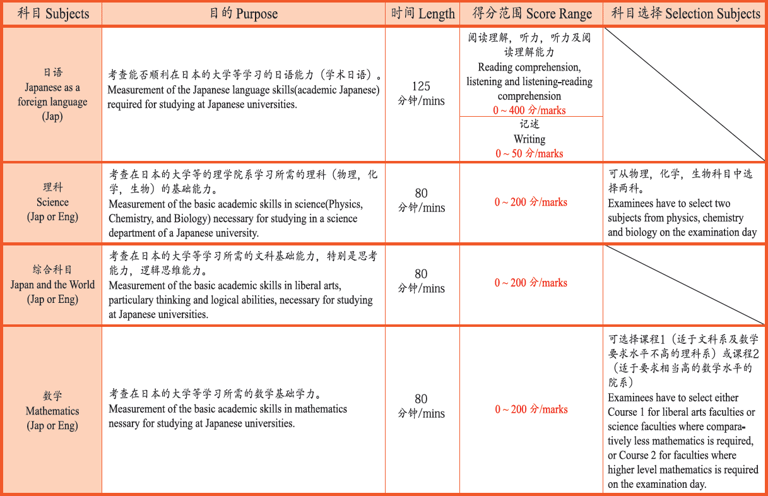
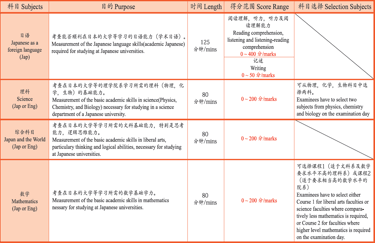
EJU is composed of four subject tests: Japanese as a Foreign Language, Science (Physics, Chemistry, and Biology), Japan and the World, and Mathematics. Exam takers who choose the Science test must select two out of the three categories, while those who opt for the Mathematics test must choose one out f the two available course options. These selections can be made at the examination site and do not need to be specified during the application process. The Science test and the Japan and the World test are scheduled at the same time, so applicants cannot take both. Applicants must make their selections based on the requirement of the university they wish to enter. Failing to do so will result in disqualification from admission to that university, so make sure to check which tests are required before applying.
Examination Subject
The Examination for Japanese University Admission for International Students (EJU) is used to evaluate whether international students who wish to study at the undergraduate level at universities or other high educational institutions in Japan possess the Japanese language skills and basic academic abilities needed to study at those institutions, Basically, it is compulsory for students to attend EJU classes if they apply for a university preparatory course, which includes learning the Japanese language and relevant EJU subjects during their time in a Japanese language school. Currently, all Japanese universities require EJU as one of the admission requirements.
Examination for Japanese University Admission (EJU)
If your academic background is less than 12 years, even if you attend a Japanese language school that offers Examination for Japanese University Examination (EJU) courses but has not been government-approved for preparatory education courses, you may not be recognized by all Japanese universities, even if you achieve EJU scores.
Examination System
Japanese universities and vocational schools require a minimum of 12 years of education (education and secondary school) as an admission requirement. This criterion poses a limitation for international students such as Malaysia SPM or IGCSE “O”-Level holders.
To address this, the Ministry of Education, Culture, Sports, Science, and Technology has established University Preparatory Courses, which allow students to study for 1 to 2 years to compensate for their education background. The University Preparatory Courses are similar to regular Japanese language courses, but students are required to take additional subjects in either humanities or science. Moreover, the class schedule is full-day, requiring more hours than regular Japanese language courses.
While there are over 600 japanese language institutions registered with the Japan government, only 24 of them are approved to offer University Preparatory Courses. Japanese language schools that provide this program undergo strict evaluations, including requirements for corporate status, teaching scale, faculty, and school size.
The University Preparatory Courses are available in three durations: 1-year, 1.5-years, and 2-years programs. However, not all Japanese language school offering University Preparatory Courses have all three program options at the same time. Some students may be capable of entering university after completing a 1-year program, but if they initially applied or a 2-years University Preparatory Courses and insists of withdraw from course, the Japanese language school may consider it as withdrawing midway and issue a “Certificate of Learning” instead of graduation certificate. This can result in some universities rejecting their application.
University Preparatory Course
Below is a list of Japanese language schools that collaborate with our center which provide preparatory education courses:
Akamonkai Japanese Language School
18m 24mFunabashi Japanese Language Academy 24m
Japanese Language School affiliated with Tokyo International University 12m 18m
Jet Academy 12m 18m
Kyushu Eisu Gakkan Japanese Language School 12m 18m
Meros Language School 12m 18m 24m
Ohara Japanese Language School 12m 18m
Osaka YMCA Japanese Language School
12m 18m 24mSendagaya Japanese College 18m 24m
Shinjuku Japanese Language Institute
12m 18m 24mThe Naganuma School 12m 18m 24m
Yamano Japanese Language School 12m 18m
12m: 12 months course available
18m: 18 months course available
24m: 24 months course available
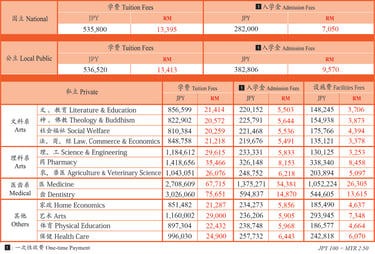
The average undergraduate tuition fees for universities per year
Japan's education system is highly esteemed globally, and the expenses are relatively affordable compared to Western nations. Regarding tuition costs, Japan provides various scholarships and tuition reduction programs for international students.
Higher Education Tuition Fees
The average tuition fees for junior colleges per year
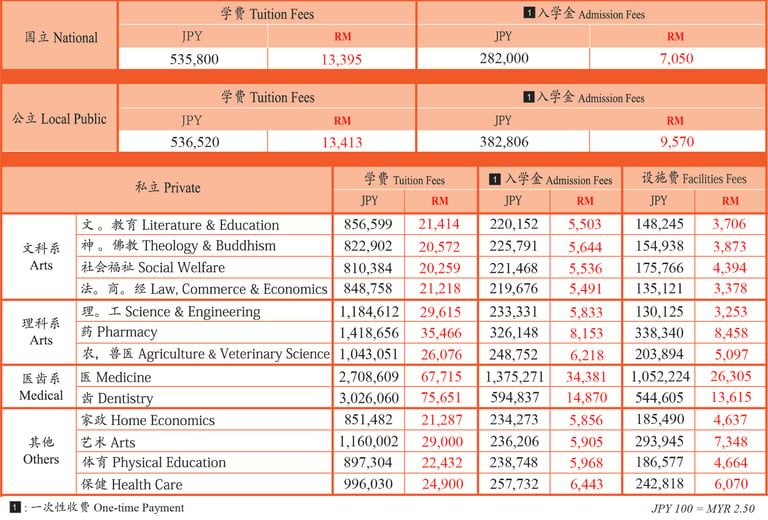
The average tuition fees for professional training college per year
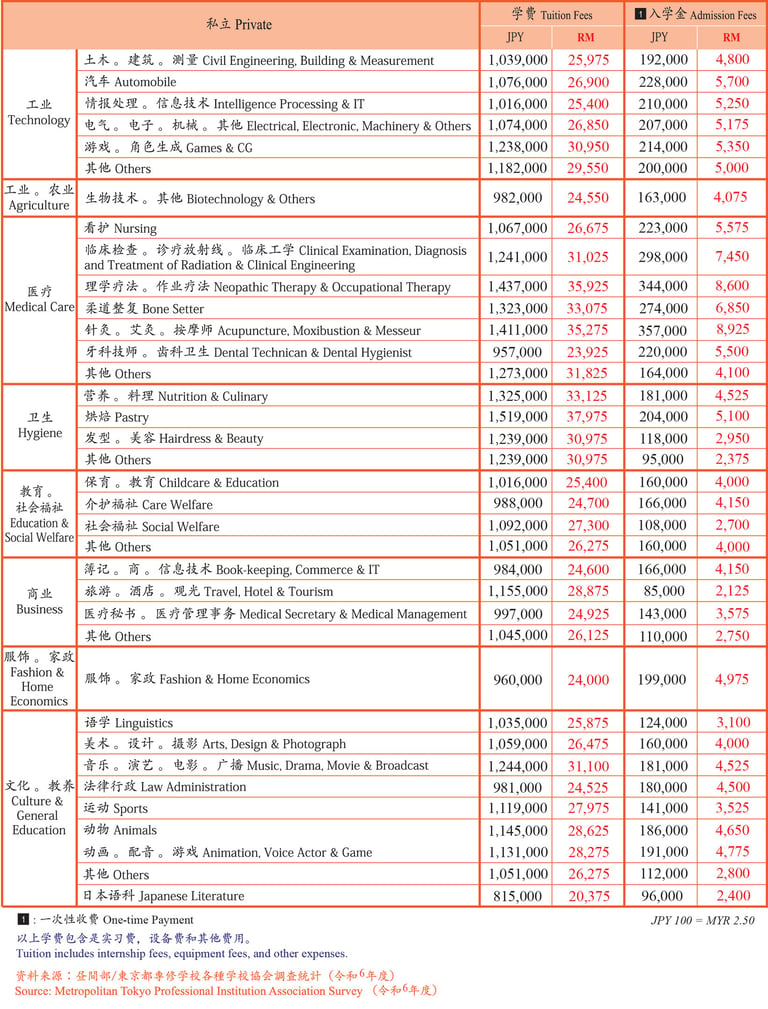
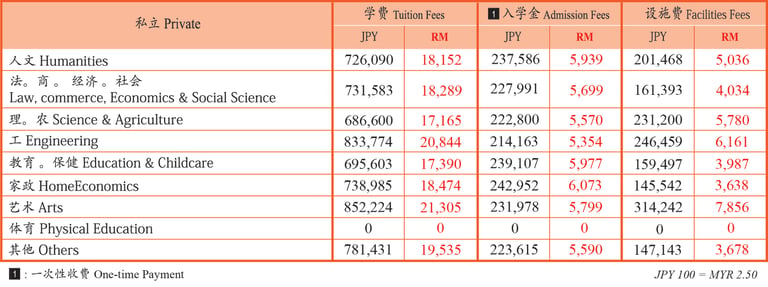
Professional Training College
University Majors
Japanese vocational colleges (Senmon Gakkō) offer practical, career‑focused education through eight major academic departments. Each department is designed to equip students with industry‑ready skills, hands‑on training, and specialized knowledge that directly connects to future employment. These departments cover a wide range of professional fields—from technology and healthcare to business, design, and social services—allowing students to pursue targeted expertise that aligns with their career goals. Below are the eight core departments, under which you may list your detailed classifications.
University (Undergraduate Faculties) & Graduate Schools (Graduate Programs)
Universities in Japan offer a wide range of academic pathways through their undergraduate faculties and graduate schools. Undergraduate faculties provide foundational and specialized education across diverse disciplines, while graduate schools focus on advanced research, professional training, and academic specialization. Together, they form a comprehensive higher‑education system that supports students in building expertise, pursuing innovation, and preparing for global careers.
View the full list here.
(Sourced from MEXT official website)
Business & Services
Bookkeeping / Business / IT / Travel / Hotel / Tourism / Medical Secretary / Medical Administration / Other Business Practices
Environmental & Biotechnology
Environment / Biotechnology
Culture, Arts & Language
Languages / Fine Arts / Design / Photography / Music / Theater / Film / Broadcasting / Law / Public Administration / Sports / Animal Studies / Anime / Voice Acting / Game Arts / Other Cultural Studies / Japanese Language Department / Preparatory School
Fashion
Fashion / Apparel Design
Lifestyle, Beauty & Culinary
Nutrition / Culinary Arts / Confectionery / Baking / Barbering / Beauty / Makeup / Esthetics / Nail Art / Others
Education & Welfare
Childcare / Early Childhood Education / Nursing Care / Caregiving / Social Welfare / Other Education / Social Welfare
Medical & Health Sciences
Nursing / Clinical Laboratory / Radiology / Clinical Engineering / Physical Therapy / Occupational Therapy / Judo Therapy / Acupuncture / Moxibustion / Massage / Shiatsu / Dental Technician / Dental Hygiene / Other Medical Fields
Engineering / Technical Fields
Civil Engineering / Architecture / Surveying / Automobile Maintenance / Information Processing / IT / Electrical / Electronic / Mechanical Engineering / Game Development / Computer Graphics
Business & Services
Bookkeeping / Business / IT / Travel / Hotel / Tourism / Medical Secretary / Medical Administration / Other Business Practices
Environmental & Biotechnology
Environment / Biotechnology
Culture, Arts & Language
Languages / Fine Arts / Design / Photography / Music / Theater / Film / Broadcasting / Law / Public Administration / Sports / Animal Studies / Anime / Voice Acting / Game Arts / Other Cultural Studies / Japanese Language Department / Preparatory School
Fashion
Fashion / Apparel Design
Lifestyle, Beauty & Culinary
Nutrition / Culinary Arts / Confectionery / Baking / Barbering / Beauty / Makeup / Esthetics / Nail Art / Others
Education & Welfare
Childcare / Early Childhood Education / Nursing Care / Caregiving / Social Welfare / Other Education / Social Welfare
Medical & Health Sciences
Nursing / Clinical Laboratory / Radiology / Clinical Engineering / Physical Therapy / Occupational Therapy / Judo Therapy / Acupuncture / Moxibustion / Massage / Shiatsu / Dental Technician / Dental Hygiene / Other Medical Fields
Engineering / Technical Fields
Civil Engineering / Architecture / Surveying / Automobile Maintenance / Information Processing / IT / Electrical / Electronic / Mechanical Engineering / Game Development / Computer Graphics
The following are the typical wages per hour that international students can earn according to government regulations effective from October of the year 2025.
Prefecture/RegionHourly Minimum Wage (JPY)
・Tokyo : ¥1,226
・Kanagawa (Yokohama) : ¥1,225
・Osaka : ¥1,177
・Saitama/Chiba : ¥1,141
・Aichi (Nagoya) : ¥1,140
・Fukuoka : ¥1,057
・Lowest Prefectures : (e.g., Okinawa, Miyazaki) ¥1,023
Salary
Student visa holders are limited to 28 hours per week without compromising their studies and it is strictly prohibited to engage in any illegal or adult industries.
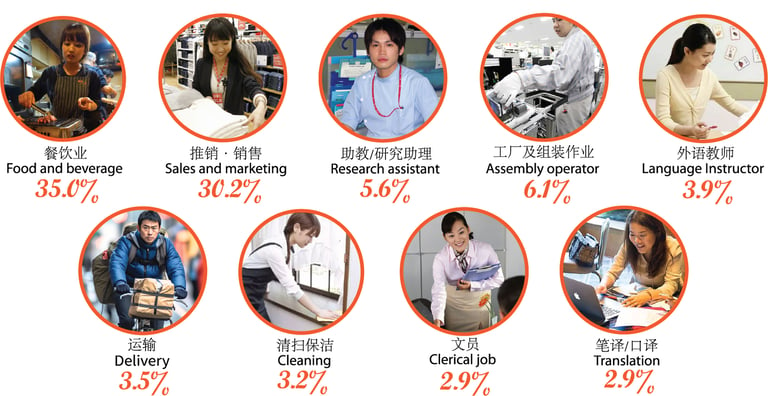
According to Jasso’s survey results for the year 2021, approximately 67% of international students work part-time. A survey conducted by EDU DOTCOM in 2024 among its enrolled students studying in Japan revealed that a high percentage of 82% of students are engaged in part-time work, which is significantly higher than the overall actual part-time work rate among international students. Students who wish to work part-time while studying in Japan are required to apply for a work permission from the Immigration Bureau of Japan. The following percentage represent the breakdown of part-time job categories from “Lifestyle Survey of Privately Financed International Students 2021 (JASSO)”.
Student Work
Important Notes
According to the Labor Standards Act, work performed between 10:00 PM and 5:00 AM must include a 25% premium.
For example, in Tokyo, the minimum late-night rate is:
JPY1,226 x 1.25 times = JPY1,533 per hourEven during a "training period," it is illegal for an employer to pay you less than the regional minimum wage.
In Japan, whether with assistance from our center and schools in job hunting or through introductions from recruitment agencies, there is absolutely no requirement for any intermediary fees. Student must be vigilant against any high agent fees claimed to assist in job replacement or study packages that include free scholarships, free accommodation, and job guarantees.
Scholarships
Japan offers a wide range of scholarships for foreign students, ranging from the central government, state government, universities, to private companies and non-profit organizations. Here are several types of scholarships that are commonly applied by international students:
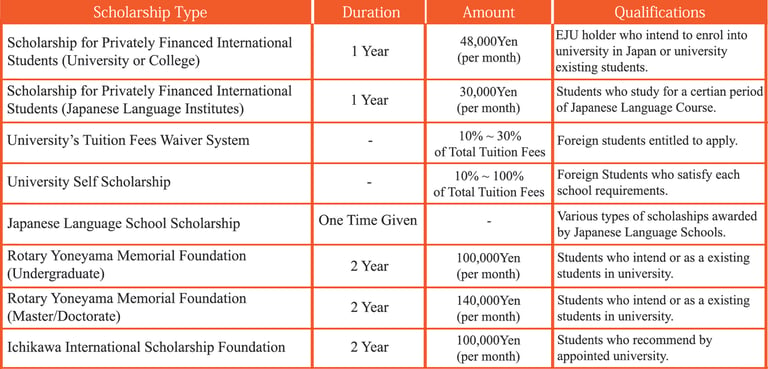
* The informations above are for reference. Please check each scholarship’s official website for the latest details.
Living Cost
* Source: 2023 Lifestyle Survey of Privately-Financed International Students (JASSO)
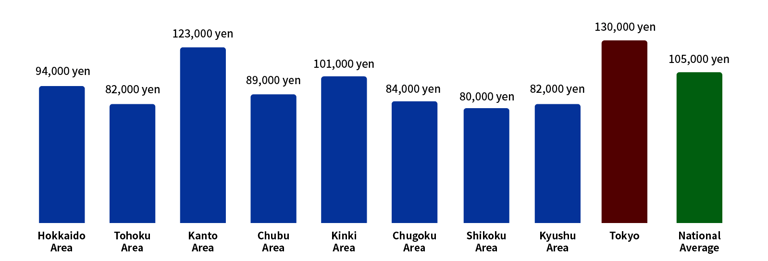
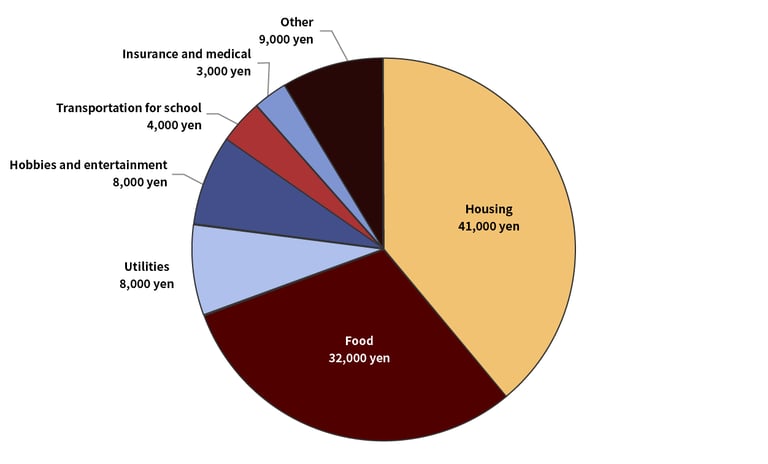
Estimated monthly living costs for international students in Japan are as follows. The rents in Tokyo and other large cities are higher than in other more rural areas. For monthly housing, while the national average is 41,000 yen, the level in Tokyo is 57,000 yen. In metropolitan areas, it is also difficult to rent apartments or other accommodations near schools, raising the level of commuting costs.
Breakdown of the average monthly cost of living (National average)
Still feeling unsure about how to begin your study journey in Japan?
Reach out for study advice or course details.
Contact
Keep an eye out for our latest news and events!
Phone
+6016-7023776 (Whatsapp)
Copyright © 2026 EDU DOTCOM. All rights reserved.
Compay Registration No.: 201203065356 (JM0618902-U)
Malaysia
No.86A, Jalan NB2 1/4,
Taman Nusa Bestari 2,
79150 Iskandar Puteri, Johor, Malaysia
Address
japan
Akabane Daiichi Hayama Bldg.4F,
1-7-9 Akabane, Kita-ku,
Tokyo 115-0045, Japan
No.86A, Jalan NB2 1/4,
Taman Nusa Bestari 2,
79150 Iskandar Puteri, Johor, Malaysia